






Table of Contents
- What Are Shipping Envelopes?
- Why Shipping Envelopes Are Essential for Online Businesses
- Shipping Envelopes vs Cardboard Boxes
- Bubble Mailers vs Poly Mailers
- Benefits of Padded Shipping Envelopes
- How Bubble Envelopes Protect Fragile Products
- Choosing the Right Shipping Envelope Size
- Best Shipping Envelopes for Small Businesses
- Best Shipping Envelopes for Etsy Sellers
- Best Shipping Envelopes for Amazon Sellers
- How to Reduce Shipping Costs with Lightweight Mailers
- Common Shipping Mistakes to Avoid
- How Packaging Impacts Customer Satisfaction
- Frequently Asked Questions
- Final Thoughts
What Are Shipping Envelopes?
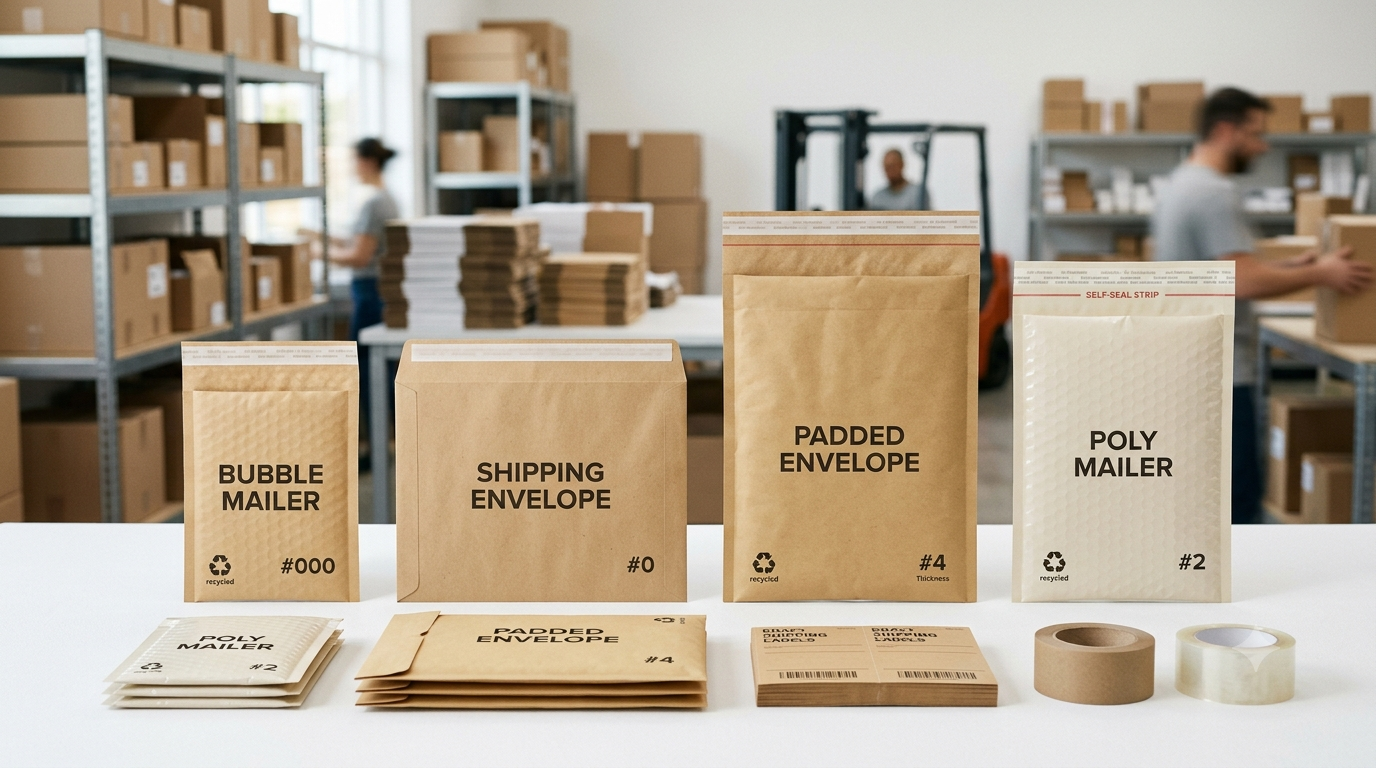
Shipping envelopes are flexible mailing containers used to send products through the mail without the bulk or cost of a cardboard box. Unlike a standard paper envelope, shipping envelopes are built specifically for durability during transit — they resist tearing, punctures, and moisture far better than ordinary office supplies.
The term covers several distinct product types, each suited to different shipping needs:
- Bubble mailers — padded with a bubble cushioning layer for fragile items
- Poly mailers — lightweight, waterproof plastic envelopes for soft goods
- Padded shipping envelopes — reinforced envelopes with foam or fiber padding
- Kraft paper mailers — sturdy paper-based envelopes for lightweight, non-fragile items
Most online sellers eventually use a combination of these depending on what they’re shipping. A clothing brand might rely heavily on poly mailers, while a jewelry seller may need padded shipping envelopes or bubble mailers to prevent damage in transit.
For sellers comparing options, ROCKLON Shipping Envelopes offers a range that covers multiple use cases in one product line, which simplifies sourcing for growing businesses.
Why Shipping Envelopes Are Essential for Online Businesses
Every online seller — whether running an Etsy shop, an Amazon storefront, or an independent eCommerce site — eventually faces the same operational question: how do I get products to customers safely, affordably, and efficiently?
Shipping envelopes solve this in three ways:
Cost control. Envelopes weigh significantly less than boxes, which directly reduces shipping costs on weight-based carrier pricing.
Speed of fulfillment. Envelopes are faster to pack than boxes. There’s no need for tape guns, box assembly, or void fill in many cases — just product, envelope, label, ship.
Storage efficiency. Flat, stackable envelopes take up a fraction of the storage space cardboard boxes require, which matters enormously for home-based sellers and small warehouses.
For businesses shipping dozens to thousands of orders per month, these three factors compound into meaningful savings on both money and time.
Shipping Envelopes vs Cardboard Boxes
This is one of the most common decisions new sellers face. Neither option is universally better — the right choice depends on the product.
Choose shipping envelopes when:
- The product is soft, flexible, or flat (clothing, documents, small accessories)
- Weight savings matter for shipping cost
- The item isn’t easily crushed or damaged by light pressure
Choose cardboard boxes when:
- The product is rigid, heavy, or oddly shaped
- The contents need structural protection from crushing
- Multiple items are being shipped together
Many sellers use both — boxes for bulkier orders, envelopes for single small items. This hybrid approach is common among Etsy and Amazon sellers managing varied product catalogs.
Bubble Mailers vs Poly Mailers
These two product types get confused constantly, but they serve different purposes.
Bubble mailers include a built-in layer of air bubble cushioning between two outer layers, similar to bubble wrap sealed inside an envelope shell. They are designed for items that need impact protection — think small electronics, cosmetics, jewelry, or anything with a delicate surface.
Poly mailers are made from a single layer of durable, water-resistant plastic film with no internal cushioning. They are built for flexibility and weather resistance rather than impact absorption — ideal for clothing, soft goods, and items that won’t be damaged by light pressure.
| Feature | Bubble Mailers | Poly Mailers |
|---|---|---|
| Cushioning | Yes | No |
| Waterproof | Mostly | Yes |
| Best for | Fragile items | Soft goods |
| Weight | Slightly heavier | Ultra lightweight |
If you’re unsure which to choose, ask one question: would this item be damaged by a light bump during transit? If yes, choose bubble mailers. If no, poly mailers will save weight and cost.
Benefits of Padded Shipping Envelopes
Padded shipping envelopes sit in a middle category — offering more protection than a poly mailer but more flexibility than a box.
Key benefits include:
- Impact resistance for moderately fragile items
- Professional appearance for branded unboxing experiences
- Tamper resistance with secure adhesive closures
- Lightweight construction compared to boxed alternatives
- Versatility across product categories — books, electronics accessories, beauty products, and small home goods all ship well in padded envelopes
For sellers building a brand reputation around product presentation, padded shipping envelopes often strike the best balance between protection and a polished customer unboxing experience.
How Bubble Envelopes Protect Fragile Products
The internal air-bubble layer in bubble envelopes works the same way standard bubble wrap does — it absorbs and disperses shock rather than transferring it directly to the product inside.
This matters most for:
- Small electronics and accessories
- Glass or ceramic items
- Jewelry and watches
- Cosmetics in glass or breakable packaging
- Collectibles and small fragile gifts
Sellers shipping these categories often see a measurable drop in damage claims and negative reviews after switching from standard envelopes or thin poly mailers to proper bubble envelopes. For sellers in fragile-goods categories, ROCKLON’s bubble mailers provide the cushioning layer needed without adding excessive bulk or weight to the shipment.
Choosing the Right Shipping Envelope Size
Sizing mistakes are one of the most common and costly packaging errors. An envelope too large wastes material and can allow products to shift during transit; too small risks damage or an inability to seal properly.
General sizing guidelines:
- Measure your product at its longest, widest, and thickest points
- Add at least half an inch of buffer space on each dimension
- For fragile items, account for extra space needed for cushioning material
- Standard sizes typically run from 4×8 inches up to 14.5×19 inches for larger soft goods
Sellers shipping a consistent product line benefit from standardizing on two or three envelope sizes rather than ordering a different size for every product variation — this simplifies inventory and reduces packaging costs through bulk ordering.
Best Shipping Envelopes for Small Businesses
Small businesses generally need packaging that balances cost, protection, and professional presentation without requiring complex inventory management.
The most practical approach for most small business shippers:
- Poly mailers for apparel, soft goods, and non-fragile items
- Padded shipping envelopes for moderately fragile items and branded presentation
- Bubble mailers reserved specifically for fragile or delicate products
Buying shipping envelopes in bulk is typically the single biggest cost-saving move available to small businesses, since per-unit pricing drops significantly at higher order volumes. This is where many sellers turn to dedicated suppliers rather than retail packs, since bulk shipping envelope options are priced specifically for recurring business shipping needs rather than one-time personal use.
Best Shipping Envelopes for Etsy Sellers
Etsy sellers face a unique packaging challenge: many products are handmade, customized, or fragile, while customers on Etsy also have higher expectations around presentation and unboxing experience than typical mass-market shoppers.
For Etsy sellers, the priority order typically looks like:
- Protection first — handmade goods are often one-of-a-kind and cannot simply be replaced from inventory if damaged
- Presentation second — Etsy buyers frequently photograph and share unboxing experiences, making envelope appearance part of the brand
- Cost efficiency third — margins on handmade goods can be tighter, making lightweight mailers valuable for shipping cost control
Padded shipping envelopes and bubble mailers are particularly popular among Etsy sellers in jewelry, ceramics, art prints, and small home decor categories.
Best Shipping Envelopes for Amazon Sellers
Amazon sellers operate under stricter packaging requirements than most platforms, particularly for FBA (Fulfilled by Amazon) inventory, which must meet Amazon’s specific prep and packaging guidelines.
Key considerations for Amazon sellers:
- Envelopes must be sealed securely enough to survive Amazon’s fulfillment center handling and sorting process
- Poly mailers are widely accepted for soft goods shipped via FBA, provided they meet Amazon’s polybag requirements
- Sellers shipping merchant-fulfilled orders have more flexibility in envelope choice than those using FBA
- Barcode and label placement must remain accessible and scannable on the envelope surface
Amazon sellers managing high order volumes typically benefit most from standardizing packaging across SKUs to streamline both prep work and fulfillment center compliance.
How to Reduce Shipping Costs with Lightweight Mailers
Shipping cost is calculated primarily on weight and dimensions by every major carrier. This makes envelope weight one of the most direct levers a seller has over recurring shipping expenses.
Practical cost reduction strategies:
- Switch from boxes to envelopes wherever the product allows it
- Choose poly mailers over padded options when cushioning isn’t necessary
- Buy in bulk to lower per-unit packaging cost
- Standardize sizes to avoid overpaying for oversized packaging
- Audit current packaging quarterly as order volume and product mix changes
Even small per-package weight reductions compound significantly across hundreds or thousands of monthly shipments, often translating into thousands of dollars in annual savings for growing sellers.
Common Shipping Mistakes to Avoid
Even experienced sellers make avoidable packaging errors that cost money or damage customer relationships.
Common mistakes include:
- Using boxes for items that would ship more cheaply in envelopes
- Choosing poly mailers for fragile items that actually need cushioning
- Oversizing envelopes, wasting both material cost and shipping weight
- Failing to test packaging durability before scaling order volume
- Not accounting for weather exposure during transit (rain, humidity) when choosing material type
- Buying packaging in small retail quantities instead of bulk, missing significant cost savings
Auditing your packaging choices against your actual return and damage-claim data is one of the most underused strategies for identifying these mistakes early.
How Packaging Impacts Customer Satisfaction
Packaging is part of the product experience, not just a delivery mechanism. Customers form impressions based on:
- Whether their item arrived undamaged
- Whether the packaging felt professional and intentional
- Whether the unboxing experience matched the price point and brand
- Whether the packaging was easy to open without frustration
Sellers who invest in appropriate, well-fitted shipping envelopes — rather than the cheapest available option regardless of fit — tend to see fewer damage complaints, fewer returns, and stronger repeat purchase behavior. This is particularly true in categories where presentation matters, such as handmade goods, beauty products, and gifts.
Frequently Asked Questions
What are shipping envelopes?
Shipping envelopes are flexible mailing containers designed to protect and transport products through postal and courier networks, available in types including bubble mailers, poly mailers, and padded shipping envelopes.
What are bubble mailers?
Bubble mailers are shipping envelopes with a built-in layer of bubble cushioning, designed to protect fragile or delicate items during transit.
What are padded envelopes?
Padded envelopes are shipping envelopes reinforced with foam, fiber, or bubble padding to provide impact protection beyond a standard paper or poly envelope.
Are bubble mailers recyclable?
Recyclability depends on the specific material composition; many bubble mailers contain mixed materials that require special recycling facilities rather than standard curbside recycling.
How much weight can bubble mailers hold?
Weight capacity varies by size and construction, but most standard bubble mailers safely support products weighing under five pounds, with heavier-duty options available for bulkier items.
Are shipping envelopes waterproof?
Poly mailers are generally water-resistant due to their plastic construction, while paper-based bubble mailers and padded envelopes offer limited water resistance unless specifically treated.
Can shipping envelopes be reused?
Many shipping envelopes can be reused for non-commercial shipping if they remain structurally intact, though sellers should use new envelopes for customer-facing shipments to maintain a professional appearance.
What are poly mailers used for?
Poly mailers are commonly used for shipping clothing, soft goods, and non-fragile items where lightweight, water-resistant packaging is prioritized over impact cushioning.
What are padded shipping envelopes used for?
Padded shipping envelopes are used for items requiring moderate impact protection, such as books, small electronics accessories, and beauty products.
What size envelope should I use?
Choose an envelope that fits your product with roughly half an inch of buffer space on each side, adjusting for any additional cushioning material needed.
Are bubble envelopes good for fragile items?
Yes, bubble envelopes are specifically designed for fragile items due to their internal cushioning layer that absorbs shock during transit.
What is the difference between bubble mailers and poly mailers?
Bubble mailers include internal cushioning for impact protection, while poly mailers are a single-layer, lightweight, water-resistant option without cushioning.
How do I reduce shipping costs with envelopes?
Reduce shipping costs by choosing the lightest envelope type appropriate for your product, buying in bulk, and standardizing sizes across your product line.
What size shipping envelope do I need for small business shipping?
Most small businesses benefit from stocking two to three standard sizes covering their most common product dimensions rather than ordering custom sizes for every item.
Where can I buy shipping envelopes in bulk?
Many sellers source shipping envelopes in bulk directly from packaging suppliers such as ROCKLON, which offers bubble mailers and padded shipping envelopes designed for recurring business shipping needs.
Final Thoughts
Choosing the right shipping envelope is a small decision with a large cumulative impact on shipping costs, product protection, and customer satisfaction. Whether you’re an Etsy seller shipping handmade goods, an Amazon seller managing high order volumes, or a small business owner scaling fulfillment operations, matching the right envelope type to the right product is one of the most cost-effective operational improvements available.
Bubble mailers, poly mailers, and padded shipping envelopes each serve distinct purposes — understanding when to use each one helps reduce damage claims, control shipping costs, and create a stronger customer experience from click to delivery.
For sellers ready to standardize their packaging strategy, ROCKLON’s shipping envelope collection offers bubble mailers and padded shipping envelopes suited to a wide range of eCommerce shipping needs.